

Digital Signage market to reach USD$16.76bn by 2032
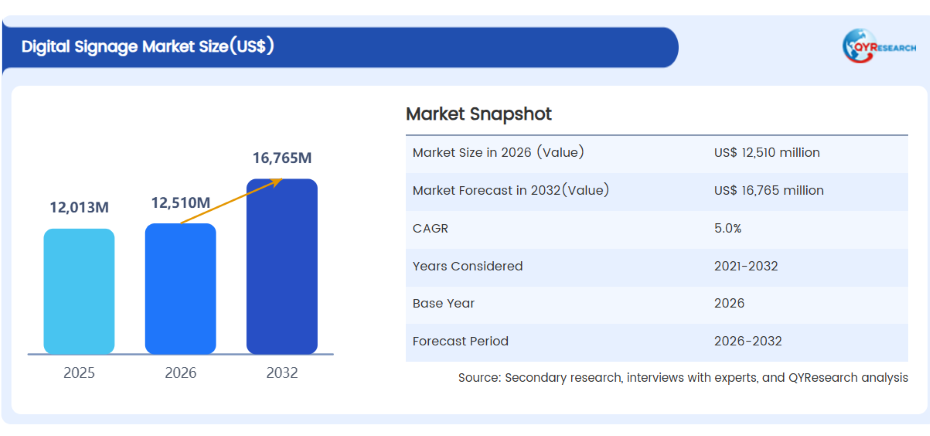
Valued at US$12.01bn in 2025, a recent industry report from QY Research, a leading global market research and consulting company, predicts that the global Digital Signage market will grow at a CAGR of 5.0% from 2026 to 2032, reaching USD$16.76bn by 2032. Future growth will be supported by retail media, brand experience upgrades, real-time public communication, transportation modernization, smart campuses, corporate digital communication, fine pitch LED adoption, and cloud-managed signage networks.
The QY Research report indicates that the Digital Signage market will continue to grow steadily as retailers, foodservice chains, enterprises, education institutions, transportation operators, healthcare providers, public authorities, and venue operators shift from static signs to dynamic, networked, and centrally managed visual communication systems.
The report says: ‘Demand is being driven by the need for faster content refresh, better customer experience, stronger brand visibility, real-time public communication, improved advertising flexibility, and data-driven operations in physical spaces. The market is also benefiting from cloud-based content management systems, mature media players, remote monitoring, improved LED performance, and lower deployment barriers for large-scale multi-region networks’.
A ‘steady but persistent’ shift towards data-driven offline operations, with retailers and restaurant chains increasingly use digital signage to manage promotions, menu boards, product launches, pricing updates, in-store advertising, and customer engagement across multiple locations, is identified in the report as one of the strongest growth drivers. Brand experience upgrades are also driving demand. Digital displays help brands create more immersive, flexible, and visually attractive environments in stores, airports, offices, campuses, hospitals, hotels, entertainment venues, and public spaces.
Transportation and public venue applications are also expanding as operators move toward real-time updates, centralised passenger information, emergency messaging, and interactive wayfinding. Fine pitch LED and high-brightness displays are penetrating faster, encouraging upgrades to larger formats, higher resolution, seamless video walls, outdoor advertising, and window-facing installations. Cloud management platforms are reducing operational complexity. Content scheduling, remote diagnostics, access control, and centralized governance make it easier for enterprises and public authorities to manage thousands of screens across regions.