
Working with 3D fabricated lettering for signage
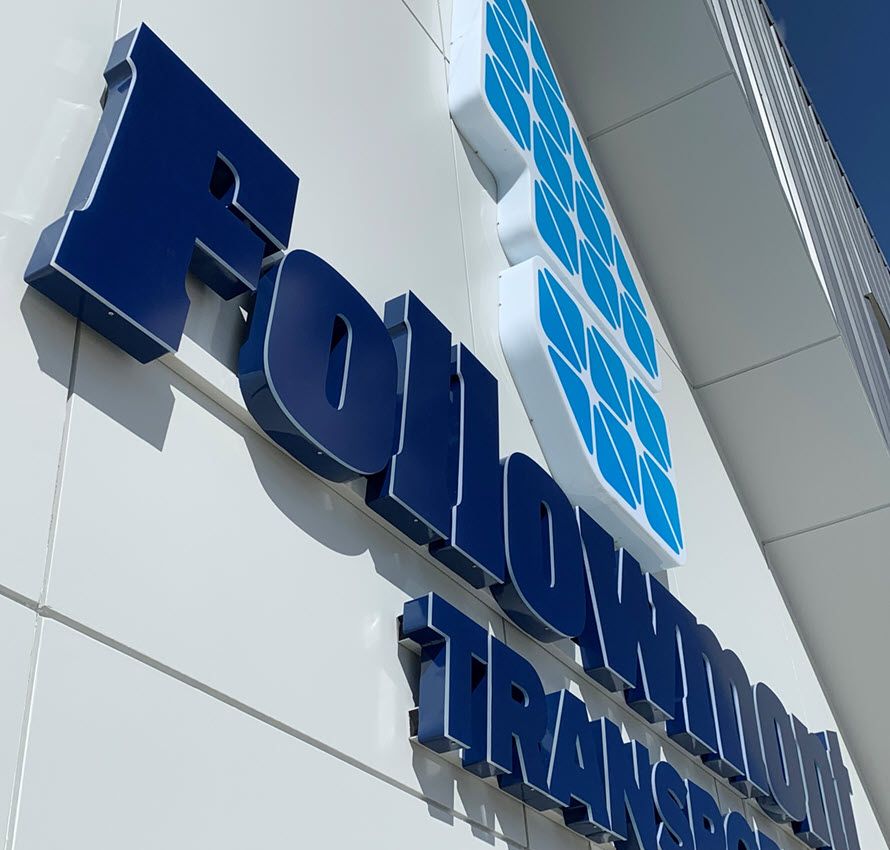
3D fabricated letters can provide lucrative work for signmakers – they are an impressive form of signage for powerful presentation of a company’s brand. Each project has its unique challenges due to the brand imagery itself, size and installation requirements that will dictate engineering requirements. In this case study, Aaron Grigg of Blair Signs and Safety, looks at how he approached the task of producing and installing 3D lettering for Followmont Transport in Mackay.
The client brief was simple – ‘a bright illuminated logo – to be seen from the highway’. So the job was to reproduce the 18 letters in 3D illuminated lettering along with a halo lit logo, and install the letters to a tilt/slab building.
“We determined the appropriate size of the lettering in scale with the building, which resulted in proposed lettering ranging from 350 to 700 mm in height which the client approved. A challenge was providing power supply to the letter with minimal holes through the building wall. We decided to mount the letters to a 50 x 25 mm aluminium rail and run the power supply through the rail to each letter. We painted the rail the colour of the wall to conceal it. Mounting the letters on a rail also made the project easier to install,” explains Aaron.
Aaron says the CNC file took around two hours to design – this was key to the success of the job.
“We are always mindful of future servicing requirements when we design. It is far easier to remove the face of a letter to replace an LED than take the letter off the wall.
“The tray base of the letters was cut from 1.6 mm aluminium inset by the thickness of the letter sides, which we also made from 1.6 aluminium. The sides of all letters could have been made from acrylic but I was more comfortable in forming aluminium as this is my expertise,” he adds.
Aaron used 1.6 mm aluminium because there was plenty in stock, but he says that in hindsight, he I would have preferred to use 0.8 mm to make the letter sides because it would have been easier to form.
“We manually formed the letter profiles using the base as a template and tack-welded. It took around 45 mins per letter to create the side profile. The 10 mm acrylic letter face was CNC routed with a rebate just wide enough for the thickness of the aluminium,” he goes on to say.
Next, a concealed screw fixed the letter to the sides and then as many LEDs as possible were fitted into the tray. The sides of the letters were painted with colour matched two- pack paint and laminated back-lit vinyl was used to finish the faces.
“The entire project was wired and pre-assembled on the rail for installation; and the dynabolts were mounted inside the letters wherever possible for a neater finish,” explains Aaron, confirming that onsite installation took three hours.